



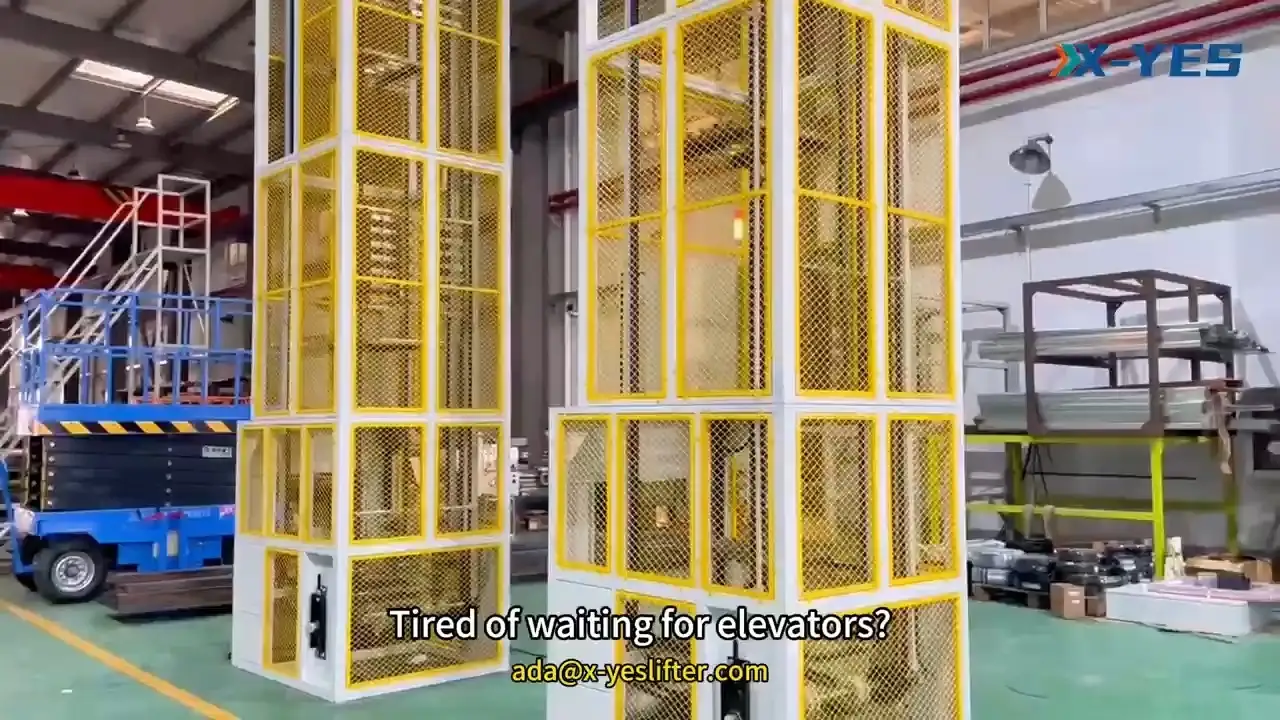
Four-Post Z-Type Reciprocating Vertical Lift – A Flexible and Efficient Heavy-Load Vertical Conveying Solution
Four-Post Z-Type Reciprocating Vertical Lift is a structurally stable and highly flexible vertical conveying device, ideal for scenarios where goods need to be loaded and unloaded from opposite sides or front-to-back directions. The design allows loading and unloading from two opposite sides or front and rear, offering multiple handling options and significantly improving operational flexibility and efficiency. Its four-post structure provides excellent load-bearing capacity, making it suitable for handling materials of various sizes and weights, especially large and heavy items. In space-constrained environments, this design enables easier operation, effectively saves space, and optimizes overall logistics flow.
Product Features
-
Z-Type Loading/Unloading: Supports Z‑type paths (opposite-side or front-to-back access), flexibly adapting to diverse logistics needs.
-
High Load Capacity: Capable of handling large, heavy, or oversized materials, meeting demanding load requirements.
-
Efficient Vertical Conveying: Provides fast and safe vertical transport, reducing cycle time and increasing productivity.
-
Multiple Safety Protections: Equipped with limit switches, fall prevention systems, emergency stop buttons, and other safety devices to fully protect operators and equipment.
Application Scenarios
The four-post Z‑type reciprocating vertical lift is widely used in applications requiring high-load, large-size material vertical transport. Typical scenarios include manufacturing plants, warehousing and logistics centers, heavy industry, automotive assembly lines, electronics, and semiconductor industries. Its flexible loading/unloading methods meet the needs of various logistics processes, especially in space-limited environments, enabling efficient and fast goods movement between multiple floors and significantly improving operational efficiency and productivity.
Customization Services
We offer comprehensive customization services to meet different application requirements. The platform size, load capacity, and lifting height can be tailored to actual site conditions, ensuring optimal fit. In addition, the equipment supports various interfacing conveying methods, including roller conveyor, chain conveyor, and plate chain conveyor, allowing flexible integration into diverse logistics processes and further enhancing operational efficiency.
